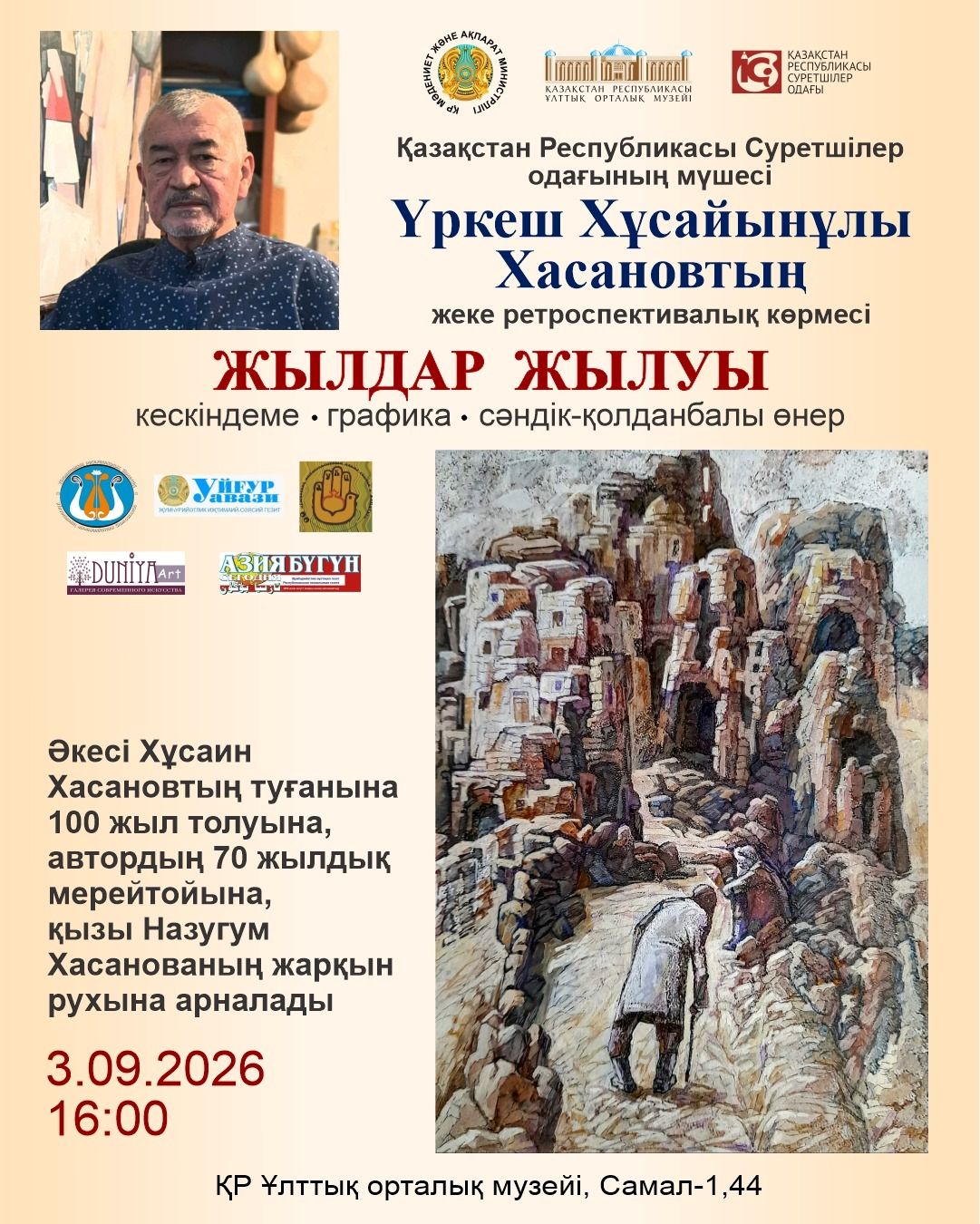
On 3 September 2026 at 4:00 p.m., the National Central Museum of the Republic of Kazakhstan will open «DISTANT YET CLOSE», a solo retrospective exhibition by Urkesh Khasanov, an artist and member of the Union of Artists of the Republic of Kazakhstan. The exhibition is dedicated to the 100th anniversary of his father’s birth, the artist’s 70th birthday, and the cherished memory of his daughter, Nazugum Khasanova.
Urkesh Khasanov graduated from the N. Gogol Alma-Ata, Art College in 1976 and from the Alma-Ata, State Institute of Theatre and Art in 1987. Throughout his professional career, he has worked as an artist, restorer, designer, and director of creative projects, successfully combining decorative and applied arts, museum conservation and restoration, architectural design, and related fields.
From 1978 to 1981, Khasanov worked at the Souvenir production factory, where he created original works of decorative art. From 1987 to 1992, he served as chief artist at the Kazkhudozhprom Special Design Bureau. Between 1991 and 1995, he headed the Restoration Department of the Central State Museum of the Republic of Kazakhstan, contributing to the preservation and restoration of cultural heritage objects. From 1995 to 2020, he was involved in the design of residential buildings, cafés, restaurants and office spaces, while also providing technical supervision of construction projects and developing interior, exterior and landscape design concepts.
 Urkesh Khasanov is one of the artists whose creative career bridges the traditions of the Soviet school of art and the contemporary art of independent Kazakhstan. Belonging to a generation of artists who received a rigorous professional education during the Soviet period, he remained faithful to his artistic vocation and continued his creative journey through a period of profound historical and social change. Despite changing eras, social transformations, and the challenges of the transition period, he has remained devoted to art. His works reflect decades of artistic exploration, accomplished craftsmanship, and a deep respect for national artistic traditions.
Khasanov’s work has been presented in numerous national and international art projects. Among the most significant were the Republican Exhibition of Decorative and Applied Arts of Kazakhstan in Alma-Ata in 1988, as well as art projects held in Yerevan, Bendery, and Yalta that same year, where his carved wooden decorative composition Alma-Ata was exhibited. In 1990, his carved wooden work Kumys Set was shown at an exhibition of decorative and applied arts in Moscow.
In subsequent years, the artist participated in the 2nd City Exhibition Under the Rays of the Sun (2009), Artists of Kazakhstan (2010), exhibitions dedicated to the Day of Uyghur Culture (2012), The Link of Times – The Link of Generations (2018), the Dunia Art-2019 project held within the framework of the Rukhani Zhangyru programme, the exhibition marking the 90th anniversary of the Union of Artists of the Republic of Kazakhstan (2023), Graphics of Kazakhstan (2024/2026), and Ulagatty Urpaq (2024).
In 2009, his solo exhibition Where the Sun Sets brought together works of painting, graphic art, and decorative and applied art.
Works by Urkesh Khasanov are held in private collections in Kazakhstan, the United States, France, Germany, Belgium, Japan, and the Republic of Korea, reflecting the interest his art has attracted beyond Kazakhstan.
The retrospective exhibition Distant Yet Close brings together the results of the artist’s many years of creative work. Its central idea is to reveal the inseparable connection between past and present, distance and closeness, personal memory and historical heritage. The exhibition reflects on the artist’s roots, family, homeland, life journey, and the events that have shaped his worldview.
A significant part of the exhibition is devoted to landscapes, including Harsh Winter, Notes of Spring, First Snow, The Wanderer, Make a Wish, and Expanses of the Alatau. These works are imbued with memories of Kazakhstan’s natural landscapes and of the places where the artist grew up, received his education, and developed as an artist. For Khasanov, this is a world that may be distant in time, yet remains infinitely close to his heart.
A special place in the exhibition is occupied by a recent series devoted to the artist’s historical homeland, East Turkestan (Xinjiang Uyghur Autonomous Region). These works depict the majestic landscapes of the Taklamakan Desert and the ancient cities of Kashgar, Turpan, Tuyoq, and Hotan. Through these images, the artist reflects on generational memory, cultural roots, and the spiritual bond between people and the land of their ancestors. For Urkesh Khasanov, these are more than geographical locations: they form a landscape of personal memory in which the distant becomes close, and the past continues to live in the present.
Drawing on his Uyghur cultural heritage, the artist incorporates images of mountains, ancient architecture and stone-built settlements into his paintings, imbuing them with a sense of longing for his ancestral homeland. His works are distinguished by mosaic-like arrangements of colour and an expressive rhythm of line, revealing a distinctive affinity with Eastern ornamental traditions.
Distant Yet Close invites visitors to reflect on time, memory and continuity between generations. Through the languages of painting and graphic art, the exhibition reveals the artist’s inner world, with each work becoming part of a broader story of life, family and homeland.
Address: Samal-1/44, Almaty
Tel.: 264-46-50