On 12 November at 3:00 p.m., the exhibition “NUMISMATIC HERITAGE AND PAPER MONEY OF KAZAKHSTAN” dedicated to the 35th anniversary of the Independence of the Republic of Kazakhstan will open at the National Central Museum of the Republic of Kazakhstan with the support of Halyk Bank. The exhibition will run from 12 to 18 November. On 15 November - National Currency Day, from 10:00 a.m. to 5:00 p.m., the National Central Museum of the Republic of Kazakhstan and Halyk Bank will hold an “OPEN DAY” event, during which residents of the country will have the opportunity to view the unique exhibition free of charge.
The tenge, one of the essential symbols of our sovereign state, holds a special place in the history of the country. The history of the tenge dates back to the Decree of the First President of the Republic of Kazakhstan dated 12 November 1993 “On the Introduction of the National Currency of the Republic of Kazakhstan”. The introduction of a national currency provided the Government of the Republic of Kazakhstan and the National Bank with an excellent opportunity to pursue independent economic and monetary policies aimed at achieving success in the country's domestic and foreign policy. Today, after 33 years in circulation, the tenge continues to demonstrate its viability as a currency.
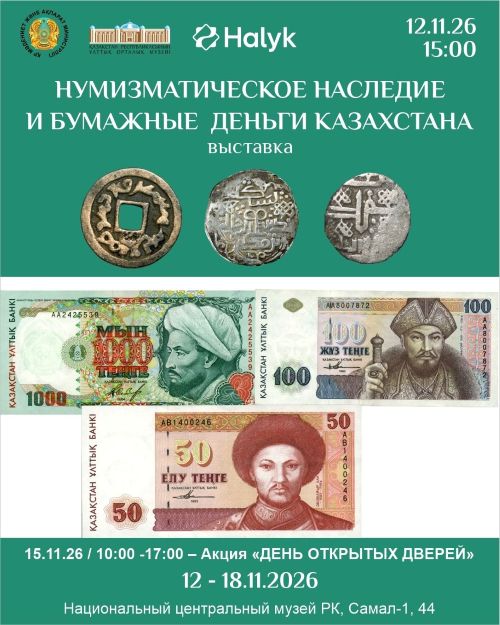 The exhibition, organized according to thematic-chronological and dynastic (state) principles, presents coins minted during various historical periods in states that existed in the territory of modern Kazakhstan and neighbouring regions: the ancient Kushan Empire (30-375 AD), the Sasanian Empire (224-651), the early medieval Turgesh State (704-756), the medieval Karakhanid State (942-1212), the Great Mongol Empire (1206-1368), the Jochi Ulus (1224-1502) and the Chagatai Ulus (1224-1370), the state of Amir Timur (1370-1507), and others. With regard to the currency of the Kazakh Khanate period, particular attention should be given to copper coins dating from the second half of the 17th century, discovered in the city of Sauran in 2015.
Silver and copper coins that circulated in the trade, economic and monetary systems of ancient and medieval states are presented both in their original form and in enlarged format, accompanied by scientific descriptions in Kazakh and Russian.
The exhibition also features various types of paper money (bonistics) and coins used during the Russian Empire and the Soviet Union, the first and subsequent issues of the national currency of the Republic of Kazakhstan the tenge as well as various numismatic collections from the years of Independence and commemorative coins.
Visitors to the exhibition will also have the opportunity to view archival documents, bonds, lottery tickets from the museum's collections, illustrations, tables and additional exhibits that provide further insight into the exhibition's theme.
For the first time, the exhibition presents new museum artefacts discovered during scientific expeditions conducted in 2021-2023 as part of the grant-funded project entitled “The Golden Horde and the Chagatai State in the Destiny of the Great Steppe: Numismatic Evidence (13th-14th Centuries)”. The expeditions covered the Turkestan, Zhambyl, Almaty and Kyzylorda regions, as well as the area surrounding the city of Shymkent. Additional artefacts were collected from local residents. These include dies for minting Karakhanid coins (Av. and Rv.), medieval weighing bowls, weights, a balance beam, blanks for the production of copper coins and silver objects used as currency.
Contact numbers: 264 36 33; 264 46 50; 264 55 77